
Historically, service trolleys have been treated as back-of-house utilities. Their primary purpose was straightforward: transport food, beverages, or service items from kitchen to guest area efficiently. Selection criteria were typically limited to load capacity, wheel mobility, and price.
In that traditional model, the trolley was never expected to contribute to brand perception. It was rarely evaluated for visual harmony. It was not considered part of architectural storytelling.
However, modern hospitality environments have changed. Guests now dine in design-led interiors. Banquet spaces are curated for experience. Luxury suites are styled with intentional material palettes. Service equipment no longer operates in the background — it moves directly within the guest’s visual field.
This shift forces a new question: Should a service trolley remain a purely functional object, or should it evolve into a strategic front-of-house asset?
The Arche Service Trolley answers that question decisively.
From Utility Equipment to Front-of-House Infrastructure
The most fundamental difference between the Arche Service Trolley and standard models lies in positioning.
Standard trolleys are built for function alone. Their aesthetic is industrial. Their proportions are mechanical. Their presence is tolerated rather than integrated.
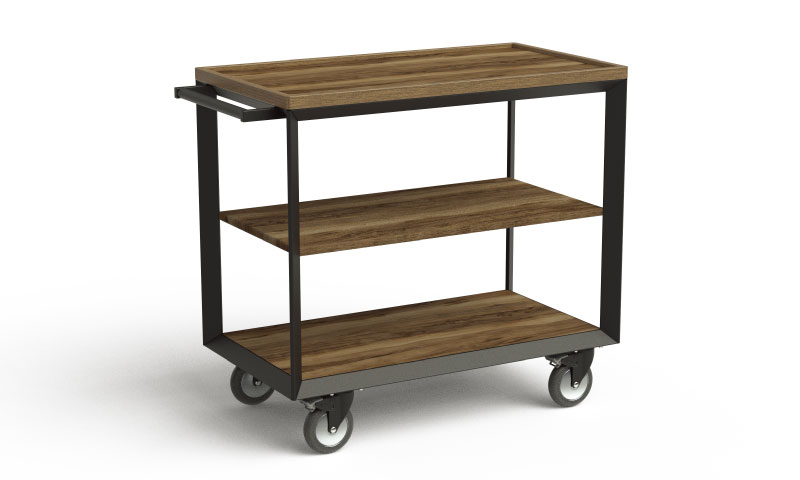
The Arche Service Trolley is intentionally designed for visible environments. Inspired by the architectural symmetry and structural discipline of Grande Arche, it incorporates proportion, balance, and material contrast into a commercial service tool.
This architectural influence is not decorative. It defines geometry, visual weight distribution, and structural clarity. The result is a trolley that can move across a fine dining room or enter an executive suite without disrupting interior harmony.
For hospitality owners, this represents a conceptual upgrade: the trolley becomes part of front-of-house infrastructure rather than a temporary service accessory.
Material Intelligence and Commercial Durability
Standard service trolleys frequently rely on exposed steel, plastic components, or laminated surfaces selected primarily for cost efficiency. While functional in controlled conditions, such materials often show wear in high-frequency commercial environments.
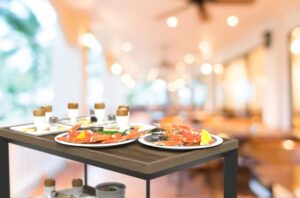
The Arche Service Trolley integrates powder-coated steel for structural integrity and ASH or OAK wood elements for warmth and visual refinement. This combination achieves dual objectives.
First, it ensures long-term commercial resilience. Powder-coated steel resists corrosion and structural fatigue. Second, it introduces a natural material contrast that aligns with contemporary hospitality interiors dominated by wood, stone, and soft finishes.
In practical B2B terms, this reduces aesthetic depreciation. A trolley that continues to look composed over time protects brand perception and lowers replacement frequency.
Procurement decisions must consider lifecycle performance, not only acquisition cost.
Workflow Engineering Rather Than Shelf Placement
Standard trolleys typically offer horizontal shelving and mobility. They fulfill transport requirements but rarely consider how staff interact with them during live service.
The Arche Service Trolley_A is designed with open accessibility that supports logical pre-service organization. The Arche Service Trolley_B introduces a more structured configuration suitable for controlled presentation and discreet service.
Beyond configuration, balance and maneuverability are engineered into the frame. Stable weight distribution reduces lateral instability during movement. This is particularly critical in banquet environments where surfaces may vary and timing is precise.
Operationally, this reduces inefficiency. Staff expend less corrective motion. Service becomes smoother. Movement feels controlled rather than reactive.
For F&B directors, improved workflow translates directly into improved execution quality.
Performance Under Banquet and Event Pressure
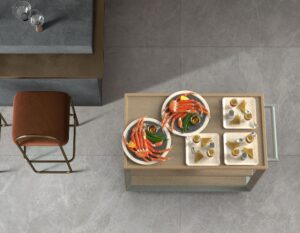
Large-scale hospitality events introduce operational stress. Banquet service involves coordinated timing, high guest volumes, and frequent movement between preparation zones and service areas.
A trolley selected purely for price may perform adequately under light usage but reveal instability under full load. Over time, wheel fatigue, frame imbalance, and visible wear compromise performance.
The Arche Service Trolley is built for sustained commercial use. Its structural integrity remains consistent under repeated service cycles. Controlled maneuverability supports confident movement even during peak operational windows.
In B2B terms, reliability during stress conditions reduces operational risk. Equipment failure during large events is not merely inconvenient; it affects service perception and brand reputation.
Multi-Department Deployment and Asset Optimization
Hospitality properties operate across multiple service formats. A trolley may support restaurant dining in one shift, banquet coordination in another, and executive suite delivery later in the day.
Standard industrial carts often feel restricted to operational corridors due to their aesthetic limitations.
The Arche Service Trolley maintains visual consistency across departments. Its refined presence allows seamless transition between environments. This improves asset utilization and strengthens return on investment.
From a B2B perspective, multi-department adaptability increases capital efficiency.
Architectural Compatibility in Contemporary Projects
Modern hospitality development increasingly prioritizes minimal design, structural clarity, and material harmony.
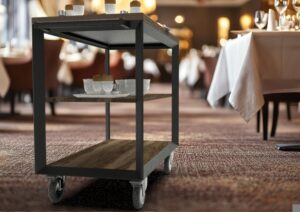
The Arche Service Trolley reflects balanced proportions and clean geometric structure, allowing it to integrate naturally into design-led hospitality environments.
For architects and project consultants, this simplifies specification. Operational equipment no longer needs to be visually concealed and can be confidently incorporated into front-of-house spaces without disrupting the overall interior concept.
Staff Performance and Service Psychology
Equipment quality influences staff behavior.
A stable trolley enhances confidence. Balanced handling improves posture. Organized shelving supports methodical preparation before guest interaction.
When staff operate confidently, service appears controlled and professional. Guests perceive smoothness even if they cannot identify its source.
This psychological dimension differentiates a thoughtfully engineered trolley from a purely functional one.
Brand Equity and Competitive Positioning
Hospitality differentiation increasingly depends on detail.
Guests may not consciously analyze a service trolley. Yet they register whether an environment feels cohesive or inconsistent.
The Arche Service Trolley supports brand narrative through visual discipline, material harmony, and operational stability. Over time, these subtle signals reinforce positioning as design-aware and professionally managed.
In competitive markets, brand reinforcement through operational consistency is a measurable advantage.
Financial Perspective: Total Cost of Ownership
Standard trolleys may appear economical at purchase. However, accelerated wear, aesthetic mismatch, and replacement frequency increase long-term expenditure.
The Arche Service Trolley prioritizes durability and timeless design. Reduced replacement cycles and consistent appearance protect capital investment.
For financial decision-makers, the evaluation shifts from purchase price to total cost of ownership and long-term brand protection.
What makes an Arche Service Trolley different from standard trolleys is not one isolated feature.
It is a comprehensive shift in approach.
Standard trolleys solve logistical movement.The Arche Service Trolley solves logistical movement while simultaneously addressing architectural alignment, workflow engineering, lifecycle durability, asset optimization, and brand reinforcement.
For hospitality decision-makers operating in competitive, design-led markets, that integration defines the difference.
You can check out our blog “Movendis Trolley Solutions: Where Design Meets Performance“